Meme coin trading on Fomo or manual DEX swaps and what works better for beginners
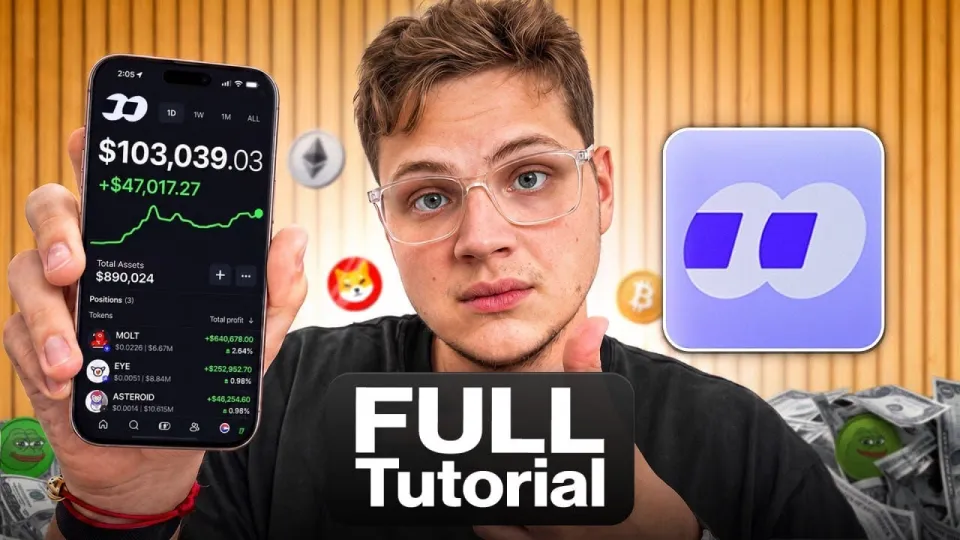
Video: How To Make Money Trading Memecoins (fomo app tutorial)
Need articles like this for your video? They help promote it on YouTube and Google — order them in the Telegram bot @sat_sit_bot. The bot writes and publishes the articles itself (with your YouTube video embedded) on popular topical websites (no ads). Free trial — 50 articles.
· based on the channel Orangie Web3
Key takeaways
- Meme coins are high-volatility tokens with no cash flow, so position sizing matters more than entry timing.
- Fomo is a web3 trading app that bundles wallet, chart and swap in one interface; the creator's referral link is fomo.family/r/orangie.
- Copy-trading large wallets usually means buying after their real entry, because size is often pre-loaded on separate accounts.
- On Solana, a swap costs a fraction of a cent in fees but slippage and failed transactions can eat a small bankroll.
- A practical beginner bankroll is money you can lose entirely; a $90 test wallet is a normal starting point, not a small one.
Meme coin trading is best approached as a high-risk speculation game where the tool matters less than the rules you set before clicking buy: a dedicated wallet, a fixed position size and a hard exit plan. For beginners who want one interface instead of five tabs, the Fomo trading app is the shortest path — you can start through the creator's Fomo registration link, which opens the platform with the referral attached. Everything else in this guide applies whether you use Fomo, a Solana DEX aggregator or a Telegram bot.
What a meme coin actually is and why the price moves so fast
A meme coin is a token whose value rests almost entirely on attention, liquidity and community momentum rather than revenue or collateral. That single fact explains the volatility: there is no earnings floor, so price is set by the marginal buyer, and when buyers stop arriving the chart gives back gains in minutes.
On Solana, where most of this activity happens, launching a token is cheap and fast, which means thousands of new pairs appear daily and only a tiny fraction keep liquidity for more than a few weeks. Practical consequences for a trader:
- Liquidity is the first number to check — a pool with a few thousand dollars can be exited by one seller and dump the price 60%.
- Holder distribution matters — if one wallet holds 20%+ of supply, that wallet is the real exit liquidity risk.
- Contract permissions matter — mint authority or freeze authority left active means supply can be inflated later.
- Age of the pair matters — a token that survived several days of trading has already passed a filter that most launches fail.
How the Fomo app fits into a meme coin workflow
The Fomo app compresses the usual meme coin workflow — wallet, chart, swap, portfolio — into a single web3 interface, which removes most of the friction that costs beginners money. Instead of juggling a wallet extension, a DEX aggregator and a charting site, you connect, fund and trade in one place, and the position shows up in your portfolio immediately.
What that changes in practice:
- Fewer failed transactions from forgotten slippage settings or wrong network selection.
- Faster reaction time, which matters when a token moves 30% in two minutes.
- A single place to see realized and unrealized PnL, so you notice when a position has doubled instead of finding out hours later.
What it does not change: the app is an execution layer, not an edge. It will not tell you which token to buy, and it will not protect you from a rug. Viewers of the Orangie Web3 walkthrough repeatedly ask for price alerts inside the platform — a fair request, because without alerts you are either watching charts constantly or missing exits. Until that exists, set alerts in a separate charting tool or accept that you will check manually.
A repeatable meme coin trade in six steps
A repeatable process beats a good pick, because the same process applied to ten trades produces a measurable result instead of a story. Here is a workflow that fits a small account.
- Fund a separate wallet with an amount you would accept losing completely. A test bankroll of $90–$200 is common; treat it as tuition, not investment capital.
- Screen the token before the chart: liquidity above roughly $50k, holders in the hundreds at minimum, no single wallet dominating supply, socials that predate the pump.
- Size the position so a total loss costs no more than 5–10% of the bankroll. On a $100 bankroll that is $5–$10 per trade — small, but it lets you take 10+ attempts.
- Enter in one order, not three. Averaging down into a falling meme coin is how small losses become account-ending ones.
- Set the exit before entry: take partial profit at 2x, move the rest to break-even, and let a runner ride only with house money.
- Log the trade — entry, exit, reason. After 20 trades the log tells you more than any influencer.
Fees on Solana swaps are negligible, often well under a cent per transaction, so the real costs are slippage and bad exits, not gas.
Copy trading and the trap of following big wallets
Copy trading looks like the simplest way to make money in meme coins, and it is also the most reliably late. Large traders frequently pre-load a position on a separate wallet before buying visibly on their main one; by the time a buy is broadcast to followers, part of the move has already happened, and followers become the exit liquidity for the original position.
A more honest use of wallet trackers is research, not execution: watch which wallets consistently buy early, note the pattern, and use it as one input among several. If you still want to follow a call, ask three questions first — how much of the supply does the caller hold, how old is the pair, and what happens to price if the caller sells everything. If the answer to the last question is "it goes to zero," you are not copy trading, you are providing liquidity for someone else's exit.
Common beginner questions and hard answers
Beginners usually ask the same handful of things, and the answers are less exciting than the marketing. Do you need a big bankroll? No — a small account forces discipline, and many traders report their first profitable stretch on a wallet under $200 after an earlier loss taught them sizing. Is it too late to start? Meme coins cycle constantly; the specific ticker changes, the mechanics do not, so learning the mechanics in a quiet week is better than learning them during a mania.
What about losing a wallet to a drainer? It happens through signing malicious approvals, not through swapping on a reputable interface, so keep a trading wallet separate from anything holding long-term assets and revoke approvals periodically. And is any of this investing? No — it is speculation with a defined maximum loss, and the moment a trade stops fitting that description it should be closed.
Risk rules that survive contact with a real market
Risk management is the only part of meme coin trading that compounds, because the market will always produce a token that breaks your rules if you let it. Three rules cover most damage: never add funds to a losing position, never hold a token through a liquidity pull to "see what happens," and never let one trade exceed the size you planned in a calm moment.
Emotional state deserves the same respect as the chart. Trading after a loss to win it back is the single most common way small accounts die; a 24-hour pause after two consecutive losses costs nothing and saves bankrolls. The same applies to green candles — taking profit in thirds (at 2x, 3x, and letting a remainder run) converts a lucky trade into a realized gain instead of a screenshot.
Useful links
- Fomo trading platform registration: https://fomo.family/r/orangie
- Orangie Web3 Discord community: https://discord.gg/memecoins
- Instagram: https://www.instagram.com/orangieyt/
Final takeaway
Meme coin trading rewards process over prediction: a separate small wallet, a screened token list, position sizes you can lose ten times in a row, and exits decided before entry. Tools like the Fomo app remove friction and make execution faster, but they do not replace the rules — which is exactly the framing in the Orangie Web3 tutorial that inspired this breakdown. Start small through the Fomo referral link, keep a trade log, and judge yourself on discipline rather than on the best single trade you ever made.
Questions & answers
Is the Fomo app enough to start trading meme coins, or do I need other tools?
Fomo covers wallet, chart and swap in one interface, which is enough for execution. Most traders still keep a separate charting tool or wallet tracker for research and price alerts, since alerts inside Fomo are a commonly requested feature rather than a given.
How much money do I need to start trading meme coins?
There is no minimum, but the amount should be money you can lose entirely. A $90–$200 test wallet is a reasonable starting point because it allows ten or more small positions, which is what actually teaches sizing and exits.
Why do people say copy trading meme coins does not work?
Because large traders often buy on a separate wallet before the buy that followers see, so the visible entry is already marked up. Followers then buy higher and become the exit liquidity when the original position is sold.
What is the fastest way to lose a small bankroll?
Averaging down into a falling token, oversizing a single trade, and re-entering immediately after a loss to win it back. Each of these turns a normal losing streak into a wiped account.
Source: How To Make Money Trading Memecoins (fomo app tutorial) · Markdown version